


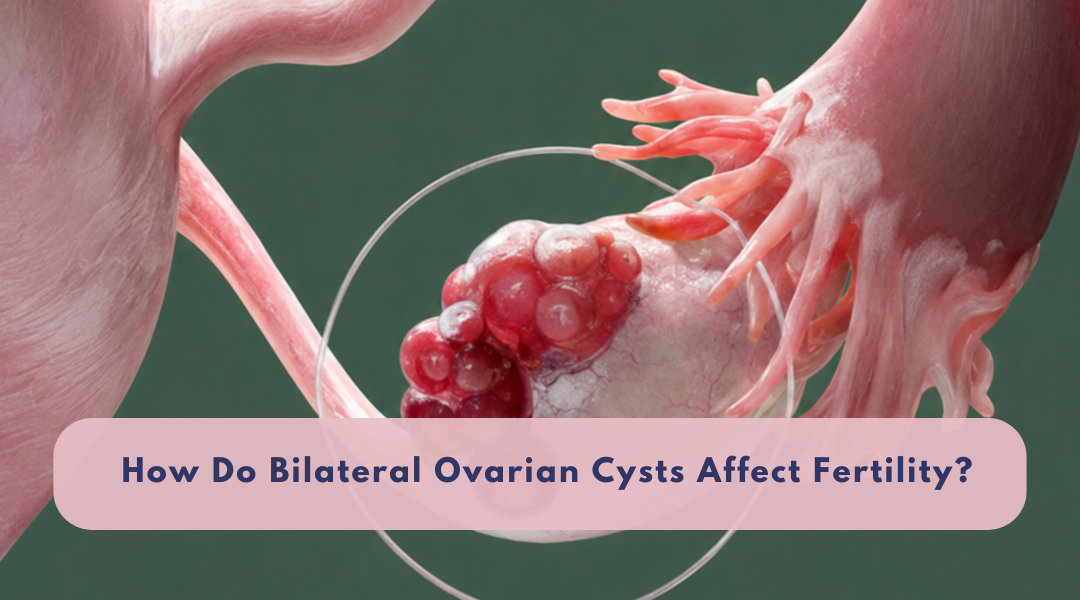
Cysts on both ovaries do not spell the same thing for every woman. Some types clear up on their own within a cycle or two and never touch fertility at all. Others, the ones connected to endometriosis or PCOS, are a different matter entirely. They chip away at ovarian reserve, knock out regular ovulation, and in some cases lower egg quality in ways that take real time to address. The cyst is usually the visible sign. What is driving it underneath is what actually determines the fertility picture.
According to Dr. Pallavi Chauhan, a Gynecologist in Andheri at her practice”Women often ask me whether cysts on both ovaries mean they cannot conceive. The cyst itself is rarely the problem. What matters is why it formed and what it is doing to the tissue around it.”
What Makes Bilateral Ovarian Cysts a Fertility Risk?
Type does most of the work here. A cyst found on both ovaries is not automatically twice the problem of one found on a single side, but the category it belongs to changes everything.
Endometriomas are the ones that warrant the most concern. These chocolate cysts bleed inside the ovary itself, and the resulting fibrosis slowly destroys healthy follicle tissue on both sides. AMH levels in women with bilateral endometriomas are measurably lower than in women with a single-sided cyst, and that gap widens the longer the disease goes unaddressed.
PCOS-related cysts sit differently. They are not true cysts in the classic sense but stalled follicles scattered across both ovaries, unable to complete ovulation. The hormonal environment driving this, elevated androgens and insulin resistance, also degrades egg quality independently of whether any individual follicle ever ruptures.
Dermoid cysts are benign but bilateral ones carry a torsion risk worth taking seriously. When an ovary twists on its ligament and blood supply cuts off, the window to salvage it is short. Slow-growing does not mean ignore it.
Simple functional cysts bilaterally are almost always a non-issue for fertility. They clear within two to three cycles in most cases, and data from ovulation induction studies shows pregnancy rates hold steady whether or not a simple cyst is sitting there at baseline.
Size matters independently of type. Anything above five centimetres starts physically crowding out follicles and reducing the available egg pool per cycle. Surgical options for cysts that reach this threshold are covered in detail on the laparoscopic ovarian surgery page.
Early diagnosis can make a difference — get checked by a specialist.
How Are Bilateral Ovarian Cysts Evaluated and Managed for Fertility?
A bilateral cyst finding on ultrasound is a starting point, not a conclusion. What follows depends on the type, the numbers, and where a woman is in her fertility plans.
AMH and AFC testing come first. Anti-Müllerian hormone and antral follicle count together show how much functional reserve is still intact. A normal AMH next to bilateral simple cysts is very different from a low AMH next to bilateral endometriomas. These results steer the conversation toward watchful waiting, ovulation induction, or faster-tracked IVF.
Surgical decisions for endometriomas above three to four centimetres involve a genuine trade-off. Removing them can reduce the inflammatory burden on the ovary, but the surgery itself risks nicking healthy ovarian cortex. When both ovaries are affected and AMH is already low, that trade-off is weighed carefully rather than defaulted to.
PCOS management rarely needs surgery as a first step. Ovulation induction with letrozole or clomiphene, sometimes paired with metformin for insulin resistance, handles most cases medically. Laparoscopic ovarian drilling stays in reserve for women who do not respond.
Earlier review beats waiting. Bilateral endometriomas do not stabilise on their own. Reserve tends to fall year on year, which means a woman who waits two years before seeking specialist input may find her options narrowed in ways that a two-year-earlier conversation might have prevented. For more on ovarian and uterine health through different procedures, the earlier post on periods after hysterectomy covers what changes and what does not.
Why Choose Dr. Pallavi Chauhan for Ovarian Cyst Management in Andheri East?
Dr. Pallavi Chauhan has been working in gynaecology and obstetrics for over a decade. MBBS, MS OBGY, DNB, MRCOG London. She consults out of Mangala Hospital, Seven Hills, Criticare Asia, and other Andheri East hospitals.Women with bilateral cysts get a proper read of their scan, not a generic summary. She explains what the findings mean for that specific case, what the reserve numbers suggest, and what the realistic options are given age and timeline. Surgery is not the first answer here by default. When it is the right call, she does it laparoscopically with ovarian tissue preservation as the priority. When it is not, she says so plainly.
FAQs
Can bilateral ovarian cysts cause permanent infertility?
Not automatically, but bilateral endometriomas left unmanaged will reduce ovarian reserve progressively over time. Getting evaluated early keeps more treatment routes open.
Do bilateral functional cysts need to be removed before trying to conceive?
Rarely. Simple functional cysts on both ovaries typically clear within a few cycles on their own and do not need to be removed before attempting natural conception or ovulation induction.
Can I get pregnant with bilateral ovarian cysts?
Yes. Many women with bilateral cysts conceive naturally or through fertility treatment. The outcome turns on what type of cyst is present, how much reserve remains, and whether an underlying condition like PCOS or endometriosis is being managed.
When should I see a doctor about bilateral ovarian cysts?
Worth seeing a specialist if cysts persist beyond two cycles, if you are dealing with pelvic pain or irregular periods, or if six months of trying to conceive have not produced a result.
Disclaimer: This blog is for informational purposes only and is not a substitute for professional medical advice. Please consult for guidance specific to your condition.
