


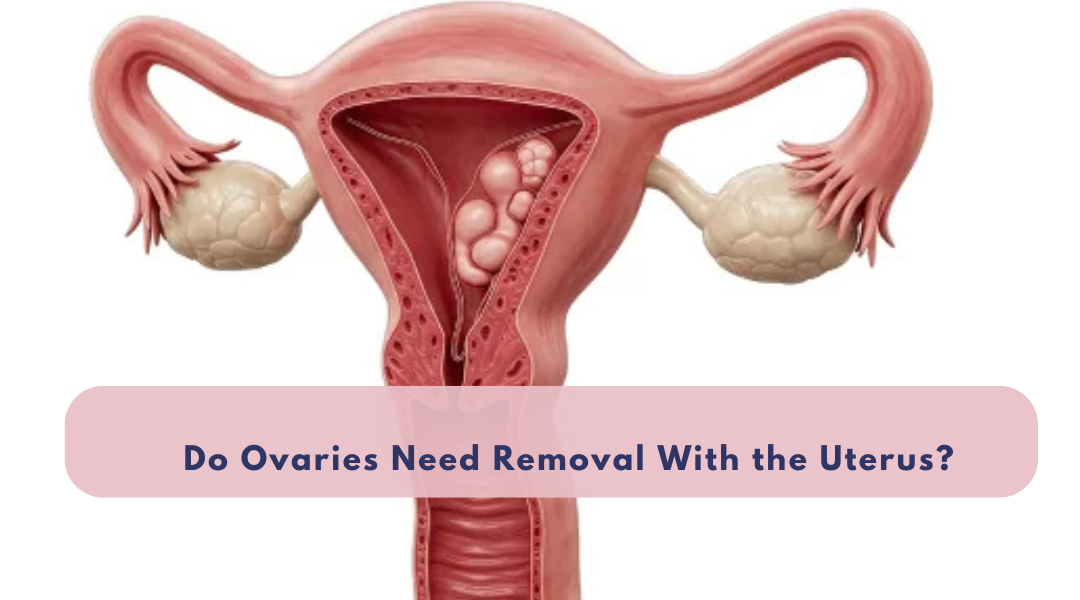
Removing the uterus and removing the ovaries are two separate decisions, and one doesn’t automatically lead to the other. Most women having a hysterectomy for common reasons, like fibroids, heavy bleeding, or prolapse, get to keep their ovaries, and their hormones keep working normally afterward. Ovaries are only removed on their own, for specific medical reasons, when those reasons are actually present.
According to Dr. Pallavi Chauhan, an experienced Gynecologist in Andheri East at her practice in Andheri East, “Women often come in believing the ovaries have to be removed with the uterus during a hysterectomy. That is not how it works. The decision to remove or preserve the ovaries is made separately, based on each woman’s age, medical history, risk factors, and overall health. “
Not sure whether your ovaries need to be removed during your hysterectomy?
When Are the Ovaries Actually Removed During Hysterectomy?
Some women do need their ovaries removed along with the uterus, though this applies to only a small number of cases, each based on a specific medical reason.
Genetic Risk :A confirmed BRCA1 or BRCA2 gene change raises the future risk of ovarian cancer, so removal is done as a preventive step against a known, documented risk.
Active Cancer : If cancer is already present in the ovaries, removal becomes a necessary part of treatment rather than a precaution.
Severe Endometriosis : When repeated surgeries have already removed most of the working ovarian tissue and the condition keeps coming back, what’s left may be causing pain without producing much benefit, so removing it can help more than keeping it.
Age and Health Findings : A woman well past menopause has less to lose from removal since her hormone levels have already changed naturally, while a woman still in her thirties or forties relies on her ovaries for ongoing hormone support, so losing them early is a bigger decision; unexpected findings during surgery, such as an infection that won’t clear with medicine or an unclear growth on a scan, can also lead to removal.
Different surgical options for hysterectomy are explained on the laparoscopic hysterectomy page.
Wondering if your ovaries need to come out with your uterus?
What Happens When the Ovaries Are Kept?
When a hysterectomy is performed for non-cancerous conditions, such as fibroids, prolapse, or heavy bleeding, keeping the ovaries in place is usually the recommended approach.
Hormones Continue : The ovaries keep working normally after the uterus is removed, so the body’s natural hormone levels stay steady even though periods stop completely.
Natural Menopause :Menopause still happens at its own natural time instead of being brought on early by the surgery.
Heart Health : Studies comparing women who kept their ovaries with those who had them removed found a higher risk of heart disease, stroke, and early death among women without ovaries, since the ovaries continue producing small amounts of hormones even after menopause that support the body in other ways.
Later Ovarian Changes : Women who keep their ovaries during hysterectomy still have a higher chance of the ovaries slowing down earlier than expected, roughly twice as likely compared to women who never had the surgery, most likely because the operation can affect blood flow to the ovaries.
The post on bilateral ovarian cysts covers how this affects fertility in related conditions.
Why Choose Dr. Pallavi Chauhan for Hysterectomy in Andheri East?
Dr. Pallavi Chauhan has over a decade of experience in gynaecology and obstetrics. MBBS, MS OBGY, DNB, MRCOG London. She operates at Mangala Hospital, Seven Hills, Criticare Asia, and other Andheri East hospitals.
The ovary decision is treated as its own conversation at every pre-operative consultation, not an assumption based on age or routine practice. A woman in her twenties gets a different discussion than a woman in her fifties, and family history of cancer, current symptoms, and scan findings all shape that conversation individually. Women leave knowing exactly what is being removed, what is staying, and the specific reason behind that choice for their case.
FAQ's
If I keep my ovaries after hysterectomy, will I still go through menopause?
Yes. The ovaries will wind down on their own eventually. Keeping them just means that process runs naturally rather than being forced by an operation.
Is removing the ovaries at hysterectomy a standard procedure?
No. For benign conditions, it is not routine. It gets decided on its own, when the clinical picture calls for it. Cancer risk, unresolvable endometriosis, something suspicious on imaging. Not otherwise.
Does keeping the ovaries after hysterectomy affect the surgery recovery?
Not really. The approach matters far more than whether the ovaries stayed or went. Laparoscopic means faster. Open means longer. Ovarian conservation barely moves that needle.
Can the ovaries be removed later if needed, after a hysterectomy?
Yes. If something changes later and the ovaries need to come out, that is done as a separate laparoscopic procedure. The original surgery does not get reopened or redone.
References
- Oophorectomy at Hysterectomy. PMC2760902. https://pmc.ncbi.nlm.nih.gov/articles/PMC2760902/
- Effect of Hysterectomy With Ovarian Preservation on Ovarian Function. PMC3223258. https://pmc.ncbi.nlm.nih.gov/articles/PMC3223258/
Disclaimer: This blog is intended for general information only and does not replace a personal consultation with a qualified gynaecologist.
